
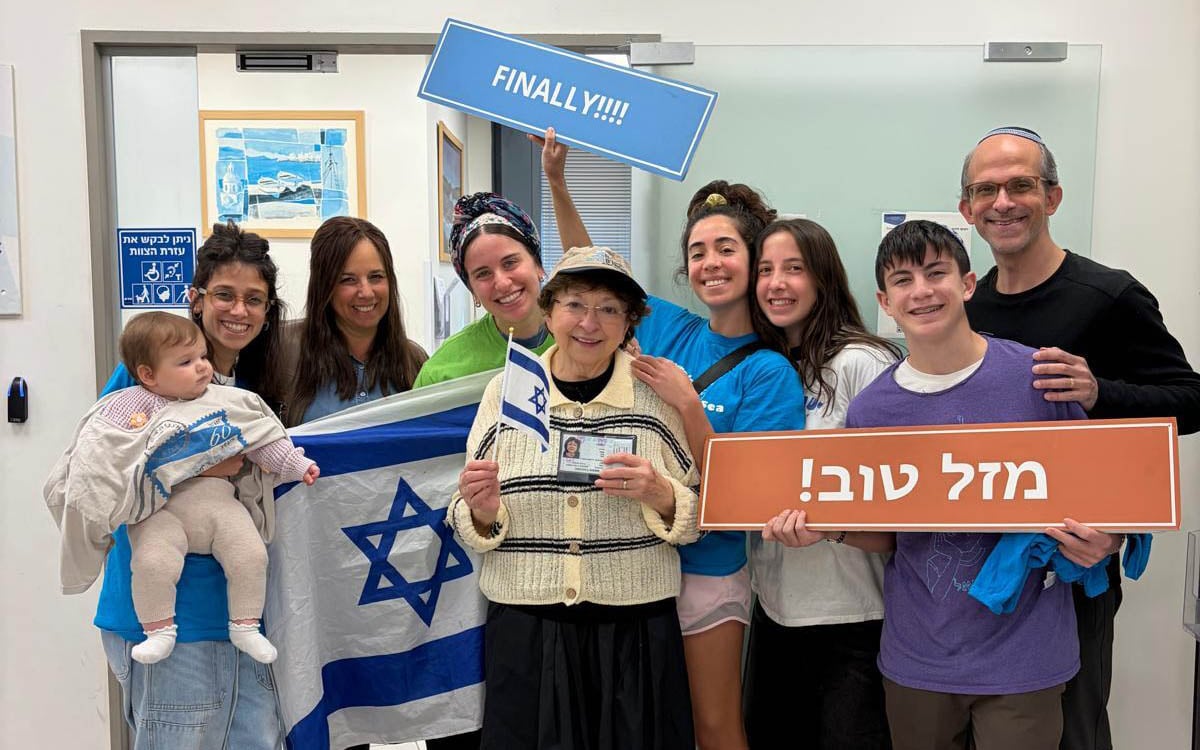
86-Year-Old Holocaust Survivor Finally Finds Home in Israel
Penina Zeitchik fled the Nazis as a toddler. Eight decades later, she fulfilled her dream of making aliyah.
A Journey That Spanned Three Continents
Penina Zeitchik was just 3 years old when the Nazis approached the small town of Lubieszow, where she lived with her family. The town had been part of Poland before World War II, but in 1939, it was occupied by the Soviet Union under the Molotov-Ribbentrop Pact.
Once home to some 1,500 Jews, the Jewish community grew during the Soviet occupation as refugees fled Nazi terror. But in 1941, Adolf Hitler broke his agreement with Josef Stalin, and within weeks, the Nazis were at Lubieszow's doorstep.
Zeitchik's parents decided to flee east, leaving town ahead of the German invasion with her mother's young sister. "We lived with my grandmother, who remained behind," recalled Zeitchik, who was born Penina Falchuk. "When we left, there was a duck in the oven, and my mother kept on telling my grandmother to make sure it would not burn. That's how sure we were that we were coming right back."
But the Falchuks would never see their house again, nor the grandmother, an uncle, aunt, and two children who lived nearby. When they returned after the war, they found their home utterly destroyed.
Survival in Uzbekistan
After leaving Lubieszow, the family kept moving deeper into Russian territory, eventually reaching the Uzbek Soviet Socialist Republic.
"The Nazis kept coming behind us, so we wandered for quite a while, until we got to Uzbekistan," Zeitchik said.
In Uzbekistan, the family was no longer targeted as Jews but still faced extreme hunger and disease. "The locals knew how to manage and find food, but for refugees like us, there was very little," she said. "My mother and her sister would take turns standing in line all night for bread. Often, by the time it was their turn, there was nothing left."
Zeitchik remembers how people "died left and right, of starvation but also of malaria and typhus." Still, her resourceful young aunt presented herself as the widow of a soldier to local authorities, found a job at the train station, and claimed Penina as her daughter so they would receive more food.
From Displaced Persons Camps to New York
When the war ended, the Soviets gave refugees permission to return home. But in Lubieszow, nothing remained. During the war, a ghetto had been established there, housing some 2,000 Jews. In 1942, most were shot and killed, and later that year the rest of the ghetto was liquidated. Only about 10 Jews who had been in the ghetto survived.
The family traveled west through Poland and into Germany with help from young volunteers from Mandatory Palestine. They spent two years in a Displaced Persons camp in Berlin and two more near Munich.
The Falchuks had hoped to join thousands immigrating illegally to British-run Palestine. "We would have ended up on the Exodus, but my sister was so young that they did not allow us to go," she said, referring to the famous ship carrying Holocaust survivors that the British blocked from disembarking.
After Israel was established, a letter from a relative living there changed their plans. "He wrote that he believed my father was too delicate for life in Israel," Zeitchik said. In 1951, the family moved to New York instead.
A Dream Deferred, Then Fulfilled
Zeitchik learned English, graduated from high school and college, became a teacher, married, and had children. For decades, she taught Judaic studies at Brooklyn's Yeshivah of Flatbush, a Modern Orthodox day school. All the while, she never gave up on her dream of moving to Israel.
After retiring in 2008, Zeitchik and her husband considered immigrating, but he fell ill and experienced severe cognitive decline. "My husband passed a year ago, and I just decided that it was time," she said.
On February 18, 2026, at age 86, she fulfilled her lifelong dream with assistance from nonprofit Nefesh B'Nefesh. She now lives with her son in Hashmonaim, near Modiin.
Much of her time in Israel has been spent in bomb shelters due to the war with Iran, which erupted 10 days after she arrived. But she remains unfazed. "I'm here with children, grandchildren, great-grandchildren, and I'm very excited," Zeitchik said. "I did not like to be woken up by sirens, but everything was okay."
The Ultimate Revenge
Ahead of her first Holocaust Remembrance Day as an Israeli citizen, Zeitchik recalled her uncle Shaya, who survived the war by joining the Partisans. When the Nazis separated families, his wife's last words to him were "Shayale, nekama" meaning revenge.
Now she sees her own arrival in Israel as fulfilling that wish. "When I come here, and I look around, and I see my family, and I see this country, I say to myself, isn't this the greatest revenge that we could ever have taken," she said. "This is our own victory, this is the revenge."